
The Prestige: Benchmarking Cognitive Visual Reasoning using Magic Tricks
Shuo Wen1,2,*
Beixi Du3, Edwin Meriaux1,2,4,
Junming Shi1,2,
Chloe Si1,
Edwin Meriaux1,2,4,
Junming Shi1,2,
Chloe Si1,
David Meger1,2
Doina Precup1,2
Gregory Dudek1,2
1McGill University 2Mila – Quebec AI Institute 3Cornell University 4Université Paris-Saclay, CentraleSupélec





Equal contribution, listed alphabetically by last name. * Correspondence to swen@utexas.edu.
40th Conference on Neural Information Processing Systems (NeurIPS 2026) · Evaluations & Datasets Track
Abstract
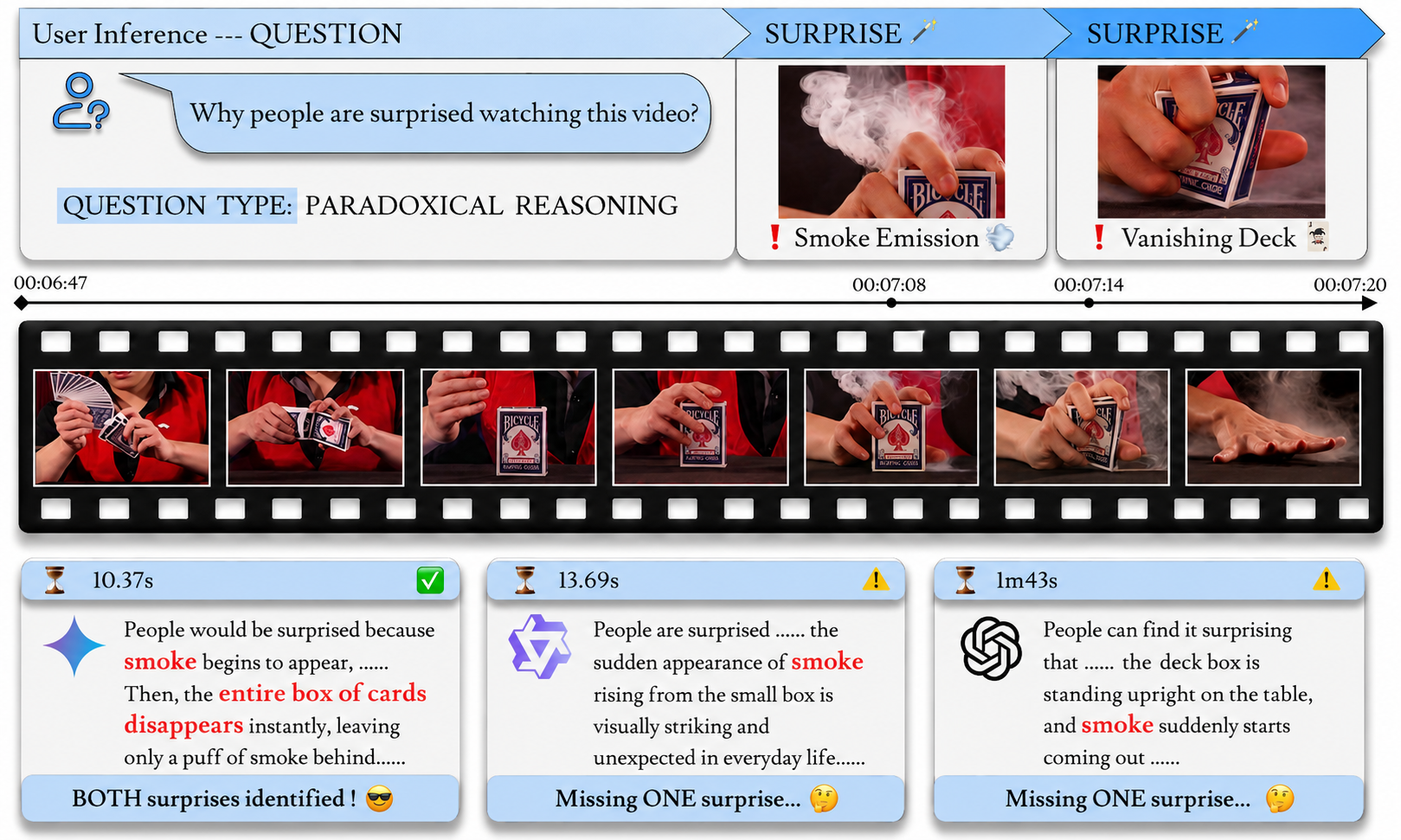
We introduce The Prestige, a video understanding benchmark that probes cognitive visual reasoning through professional magic performances, where deliberate misdirection challenges models to track events and explain unexpected outcomes. The benchmark comprises open-ended questions ranging from temporal and causal understanding to robustness against adversarial questions. Evaluation of leading open-weight and proprietary VLMs reveals a substantial gap between even the strongest model and human performance. We also find systematic discrepancies between human and automated grading and identify recurring model failure modes. Ablations further show that models can select correct multiple-choice answers even when they fail to generate correct explanations independently, motivating further investigations into question formats. Together, these results highlight limitations in both VLM reasoning and its evaluation, informing the development of more reliable video understanding models and benchmarks.
The Benchmark
Selected videos are professional, ethical, and high-resolution. They must be entirely comprehensible through visual cues alone, independent of audio or text, and not captioned, and the performances must demonstrate intentional causal coherence and high contextual density.
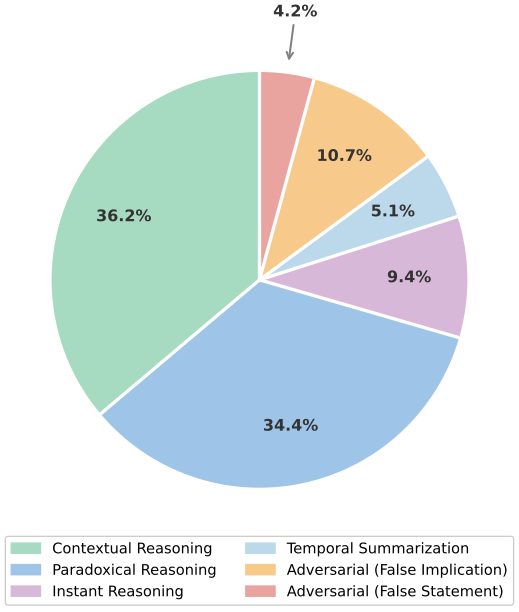
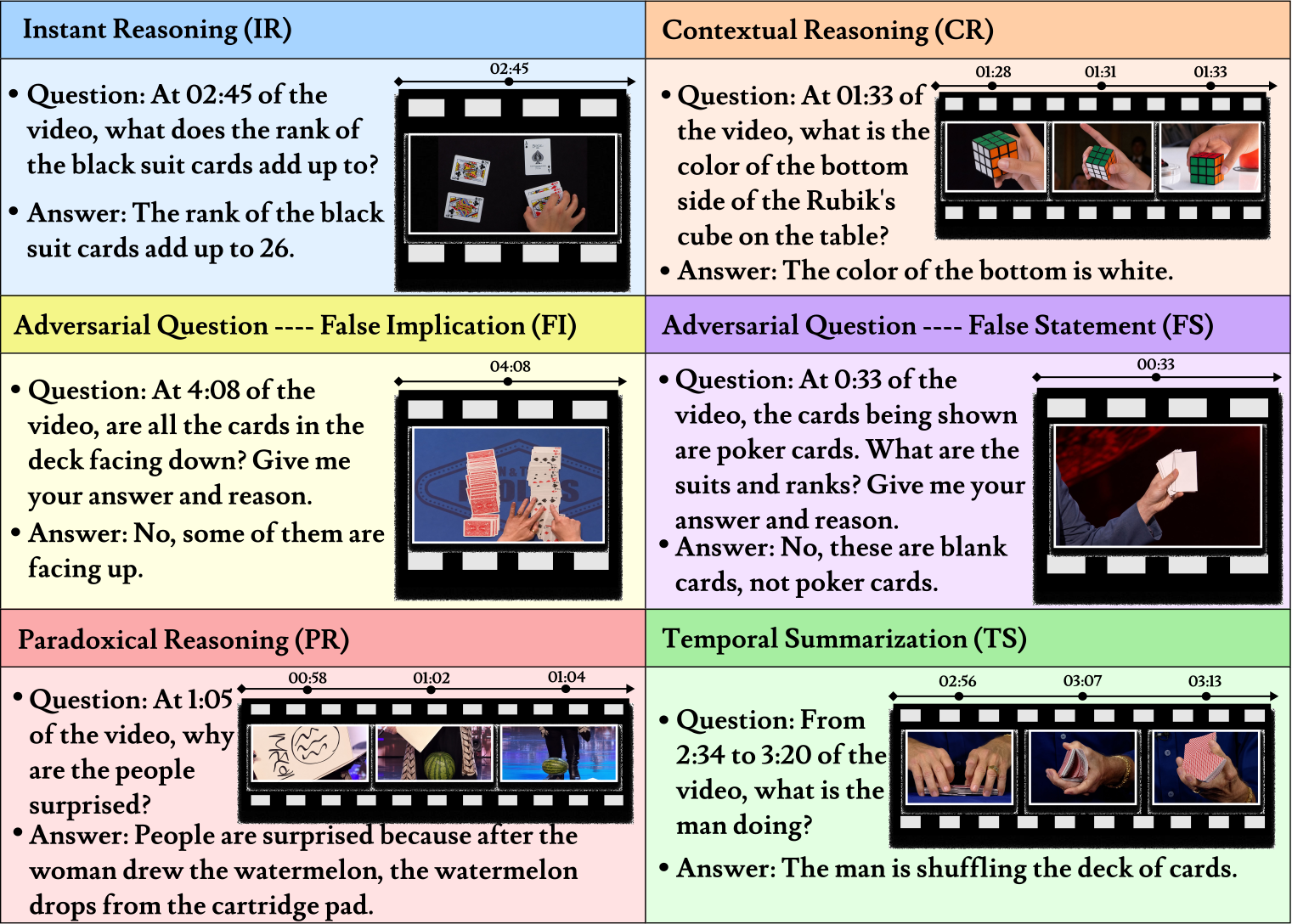
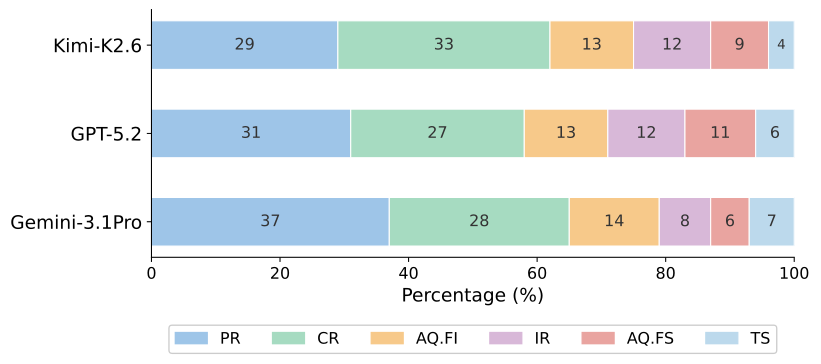
The benchmark contains 180 videos and 2,177 open-ended questions, drawn from unique routines performed by over 150 magicians across multiple platforms. The questions fall into six categories, each targeting distinct aspects of visual, temporal, and common-sense reasoning in multi-step and long-dependency settings.
| Type | Abbr. | Share | What it tests |
|---|---|---|---|
| Instant Reasoning | IR | 9.4% | Describing the complete, question-relevant visual state at a single moment, using only what is visible in the current frame. |
| Contextual Reasoning | CR | 36.2% | Using memory and relational reasoning to answer questions about a specific moment from earlier video evidence, such as tracking an object through occlusion or remembering which card was signed. The current frame alone is insufficient. |
| Paradoxical Reasoning | PR | 34.4% | Explaining why an outcome is surprising by tracking the earlier setup, reasoning about what should happen under common-sense expectations, and identifying how the observed outcome differs. |
| Adversarial Questions—False Implication | AQ.FI | 10.7% | Recognizing a false assumption implied by the question, checking it against the video, and rejecting the ungrounded framing rather than answering within it. |
| Adversarial Questions—False Statement | AQ.FS | 4.2% | Recognizing an explicit claim that contradicts the video and rejecting it rather than accepting it or inventing supporting details. |
| Temporal Summarization | TS | 5.1% | Producing a compact, high-level summary of a specified time interval that captures the essential details while suppressing both low-level details and overgeneralizations. |
Comparison with Existing Benchmarks
| Dataset | # videos | # QA | Format | Common-sense | Cognitive Flow | Multi-step | Long-context | Annotation |
|---|---|---|---|---|---|---|---|---|
| FunQA | 4,365 | 311,950 | QA | ✓ | △ | ✗ | ✗ | Manual+LLM |
| Video-MME-v2 | 800 | 3,200 | 8-way MC | ✓ | ✗ | ✓ | ✓ | Manual |
| Causal-VidQA | 26,900 | 107,600 | MC | ✓ | ✗ | ✗ | ✗ | Manual |
| VRBench | 960 | 8,243 | MC&QA | ✗ | ✗ | ✓ | ✓ | Manual+LLM |
| Video-Holmes | 270 | 1,837 | MC | ✓ | ✗ | ✓ | ✗ | Manual+LLM |
| CG-Bench | 1,219 | 12,129 | MC&QA | ✗ | ✗ | ✓ | ✓ | Manual |
| MMR-V | 317 | 1,257 | MC | ✓ | ✗ | ✓ | ✓ | Manual |
| LongVideoBench | 3,763 | 6,678 | MC | ✗ | ✗ | ✗ | ✓ | Manual |
| LVBench | 103 | 1,549 | MC | ✗ | ✗ | ✓ | ✓ | Manual+LLM |
| Ours | 180 | 2,177 | Open QA | ✓ | ✓ | ✓ | ✓ | Manual |
Results
Gemini3.1-Pro performs best overall at 47.08%, but remains 45.71 percentage points below the human baseline (92.79%). No model leads every category. The strongest open-source models, Kimi-K2.6 (39.37% overall) and Qwen3.6 (38.26%), both outperform GPT-5.2 (37.67%).
| Model | Size | IR | CR | PR | AQ.FI | AQ.FS | TS | Overall |
|---|---|---|---|---|---|---|---|---|
| Open-source models | ||||||||
| Qwen3VL-Thinking | 8B | 40.00 | 34.69 | 9.76 | 24.46 | 15.22 | 17.86 | 23.84 |
| Qwen3VL-Instruct | 8B | 46.34 | 39.90 | 17.25 | 18.88 | 20.65 | 29.46 | 29.12 |
| InternVideo2.5-Chat | 8B | 30.24 | 27.57 | 3.74 | 3.86 | 5.43 | 8.93 | 15.20 |
| InternVL3.5 | 8B | 25.37 | 26.81 | 4.14 | 19.31 | 9.78 | 12.50 | 16.63 |
| MiMo-VL-SFT-2508 | 7B | 22.44 | 22.11 | 1.87 | 21.89 | 15.22 | 8.04 | 14.15 |
| MOSS-VL-Instruct | 11B | 36.59 | 33.16 | 12.43 | 30.47 | 7.61 | 28.57 | 24.76 |
| Qwen3.6 | 35A3B | 51.71 | 48.16 | 28.34 | 31.76 | 21.74 | 37.50 | 38.26 |
| Cambrian-S | 7B | 24.88 | 22.36 | 4.55 | 20.17 | 8.70 | 10.71 | 15.07 |
| Keye-VL-1.5 | 8B | 30.73 | 27.83 | 5.61 | 23.18 | 14.13 | 10.71 | 18.51 |
| Kimi-K2.6 | 1.1TA32B | 54.15 | 47.14 | 31.28 | 30.47 | 27.17 | 40.18 | 39.37 |
| Proprietary models | ||||||||
| GPT-5.2 | UKN | 53.17 | 46.12 | 29.41 | 30.47 | 15.22 | 38.39 | 37.67 |
| Gemini3.1-Flash-Lite | UKN | 55.12 | 49.94 | 34.89 | 41.63 | 18.48 | 41.96 | 42.63 |
| Qwen3.6-Plus | UKN | 49.76 | 51.46 | 35.16 | 28.33 | 16.30 | 39.29 | 41.11 |
| Gemini3.1-Pro | UKN | 52.68 | 50.44 | 43.32 | 45.06 | 55.43 | 35.71 | 47.08 |
| Human baseline | NA | 93.17 | 93.01 | 94.39 | 91.42 | 83.70 | 90.18 | 92.79 |
Human vs. Machine Grading
Machine grades are determined by majority vote among three LLM graders, each evaluating every model response with the corresponding video frames. Human grading yields higher overall scores for every model, with a mean gap of 4.56 percentage points (SD 1.23). TS has the largest mean difference (7.40 points) and CR the smallest (3.39 points).
| Model | IR | CR | PR | AQ.FI | AQ.FS | TS | Overall |
|---|---|---|---|---|---|---|---|
| Open-source models | |||||||
| Qwen3VL-Thinking-8B | 7.80 | 3.81 | 6.42 | 3.86 | 10.87 | 8.04 | 5.60 |
| Qwen3VL-Instruct-8B | 8.78 | 5.47 | 8.96 | 4.29 | 9.78 | 13.39 | 7.44 |
| InternVideo2.5-Chat-8B | 6.83 | 4.32 | 2.54 | 0.86 | 4.34 | 7.14 | 3.72 |
| InternVL3.5-8B | 7.81 | 3.18 | 2.94 | 3.86 | 3.26 | 10.71 | 4.00 |
| MiMo-VL-SFT-2508-7B | 8.29 | 2.80 | 1.07 | 7.30 | 8.70 | 3.58 | 3.49 |
| MOSS-VL-Instruct-11B | 4.39 | 2.66 | 5.21 | 5.58 | 6.52 | 16.96 | 4.92 |
| Qwen3.6-35A3B | 6.83 | 4.96 | 9.22 | −2.57 | 6.52 | 11.61 | 6.20 |
| Cambrian-S-7B | 6.83 | 3.17 | 3.21 | 8.15 | 8.70 | 6.25 | 4.46 |
| Keye-VL-1.5-8B | 5.85 | 2.93 | 2.27 | 2.58 | 6.52 | 2.67 | 3.08 |
| Kimi-K2.6-1.1TA32B | 1.95 | 1.90 | 6.95 | −3.44 | 1.08 | 12.50 | 3.59 |
| Proprietary models | |||||||
| GPT-5.2 | 5.37 | 3.17 | 1.74 | 15.45 | 6.52 | −0.90 | 4.14 |
| Gemini3.1-Flash-Lite | 7.80 | 3.69 | 5.61 | 3.86 | 1.09 | 6.25 | 4.78 |
| Qwen3.6-Plus | 5.86 | 3.43 | 9.09 | −0.85 | 2.17 | 4.47 | 5.14 |
| Gemini3.1-Pro | 2.44 | 2.03 | 5.62 | 3.86 | −1.09 | 0.89 | 3.30 |
| AVG SD | 6.20 2.08 | 3.39 1.01 | 5.06 2.83 | 3.77 4.76 | 5.36 3.63 | 7.40 5.13 | 4.56 1.23 |
Full machine-graded results
| Model | Size | IR | CR | PR | AQ.FI | AQ.FS | TS | Overall |
|---|---|---|---|---|---|---|---|---|
| Open-source models | ||||||||
| Qwen3VL-Thinking | 8B | 32.20 | 30.88 | 3.34 | 20.60 | 4.35 | 9.82 | 18.24 |
| Qwen3VL-Instruct | 8B | 37.56 | 34.43 | 8.29 | 14.59 | 10.87 | 16.07 | 21.68 |
| InternVideo2.5-Chat | 8B | 23.41 | 23.25 | 1.20 | 3.00 | 1.09 | 1.79 | 11.48 |
| InternVL3.5 | 8B | 17.56 | 23.63 | 1.20 | 15.45 | 6.52 | 1.79 | 12.63 |
| MiMo-VL-SFT-2508 | 7B | 14.15 | 19.31 | 0.80 | 14.59 | 6.52 | 4.46 | 10.66 |
| MOSS-VL-Instruct | 11B | 32.20 | 30.50 | 7.22 | 24.89 | 1.09 | 11.61 | 19.84 |
| Qwen3.6 | 35A3B | 44.88 | 43.20 | 19.12 | 34.33 | 15.22 | 25.89 | 32.06 |
| Cambrian-S | 7B | 18.05 | 19.19 | 1.34 | 12.02 | 0.00 | 4.46 | 10.61 |
| Keye-VL-1.5 | 8B | 24.88 | 24.90 | 3.34 | 20.60 | 7.61 | 8.04 | 15.43 |
| Kimi-K2.6 | 1.1TA32B | 52.20 | 45.24 | 24.33 | 33.91 | 26.09 | 27.68 | 35.78 |
| Proprietary models | ||||||||
| GPT-5.2 | UKN | 47.80 | 42.95 | 27.67 | 15.02 | 8.70 | 39.29 | 33.53 |
| Gemini3.1-Flash-Lite | UKN | 47.32 | 46.25 | 29.28 | 37.77 | 17.39 | 35.71 | 37.85 |
| Qwen3.6-Plus | UKN | 43.90 | 48.03 | 26.07 | 29.18 | 14.13 | 34.82 | 35.97 |
| Gemini3.1-Pro | UKN | 50.24 | 48.41 | 37.70 | 41.20 | 56.52 | 34.82 | 43.78 |
Error Analysis
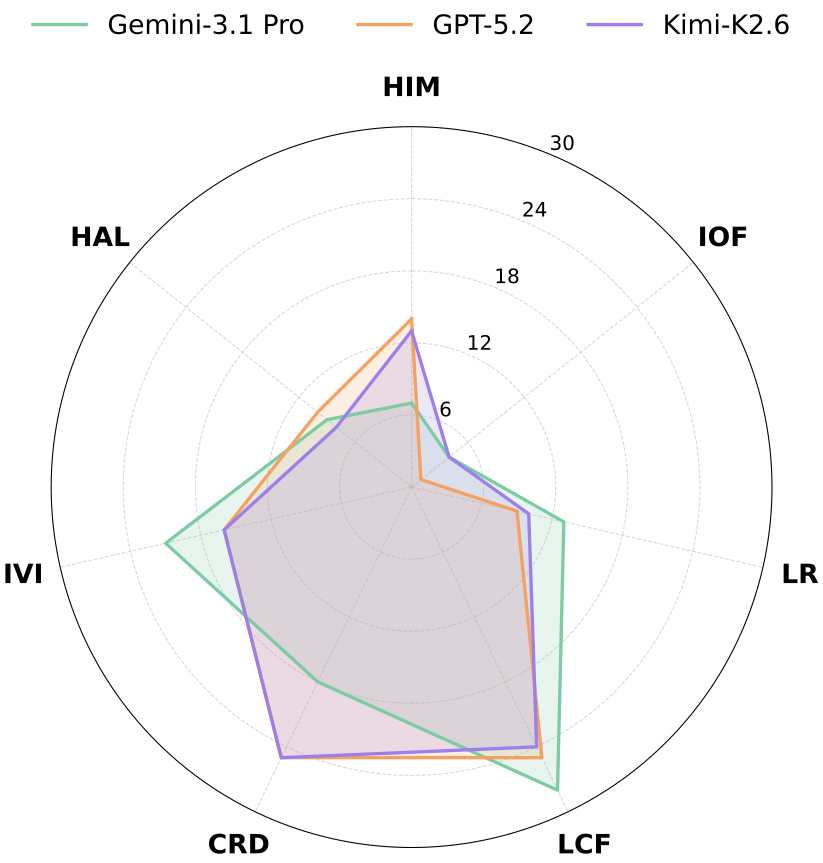
We randomly sample 100 incorrectly answered questions from each of Gemini3.1-Pro, GPT-5.2, and Kimi-K2.6, and manually assign each sampled error to one of seven error categories.
| Error type | Abbr. | Description |
|---|---|---|
| Incorrect Visual Identification | IVI | Incorrect recognition of evidence directly visible at the queried timestamp, such as misidentifying objects, misreading card ranks or suits, or miscounting items. |
| Context Referral Deficiency | CRD | Failure to retrieve information established earlier, such as a previously shown object identity or a hidden object location. |
| Lack of Cognitive Flow | LCF | Failure to connect the setup, misdirection, and reveal of a routine, or reuse of an earlier surprise to explain a later, distinct one. |
| Lack of Robustness | LR | Accepting a misleading or false premise in the question instead of rejecting it and grounding the answer in visual evidence. |
| Incorrect Output Formatting | IOF | Failure to follow the required response format, such as never-ending responses, refusals to answer, or missing required components. |
| Human Intention Mismatch | HIM | Plausible or partially correct answers that fail to match the intended specificity or reasoning target of the question. |
| Hallucination | HAL | Unsupported visual or causal claims, including invented objects, nonexistent actions, or incorrect surprises that substantially diverge from the ground truth. |
LCF, CRD, and IVI together account for 67%, 66%, and 65% of sampled errors in Gemini3.1-Pro, GPT-5.2, and Kimi-K2.6, respectively, identifying cognitive-flow reasoning, long-context reference, and local visual identification as the dominant failure modes.
Open-ended vs. Multiple-choice
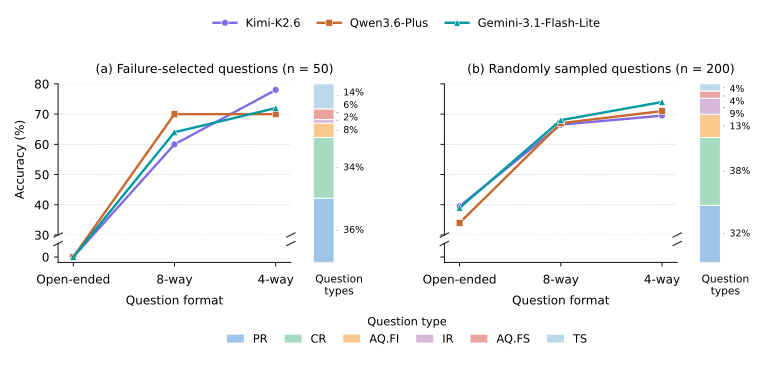
We compare open-ended answering with 8-way and 4-way multiple-choice answering on Qwen3.6-Plus, Kimi-K2.6, and Gemini3.1-Flash-Lite. On 200 randomly sampled questions, mean accuracy rises from 37.5% for open-ended answering to 67.2% for 8-way and 71.5% for 4-way multiple choice. On 50 questions that all three models failed in the open-ended setting, the mean 4-way gain is 73.3 percentage points.
BibTeX